Goodbye Developer, Hello Association
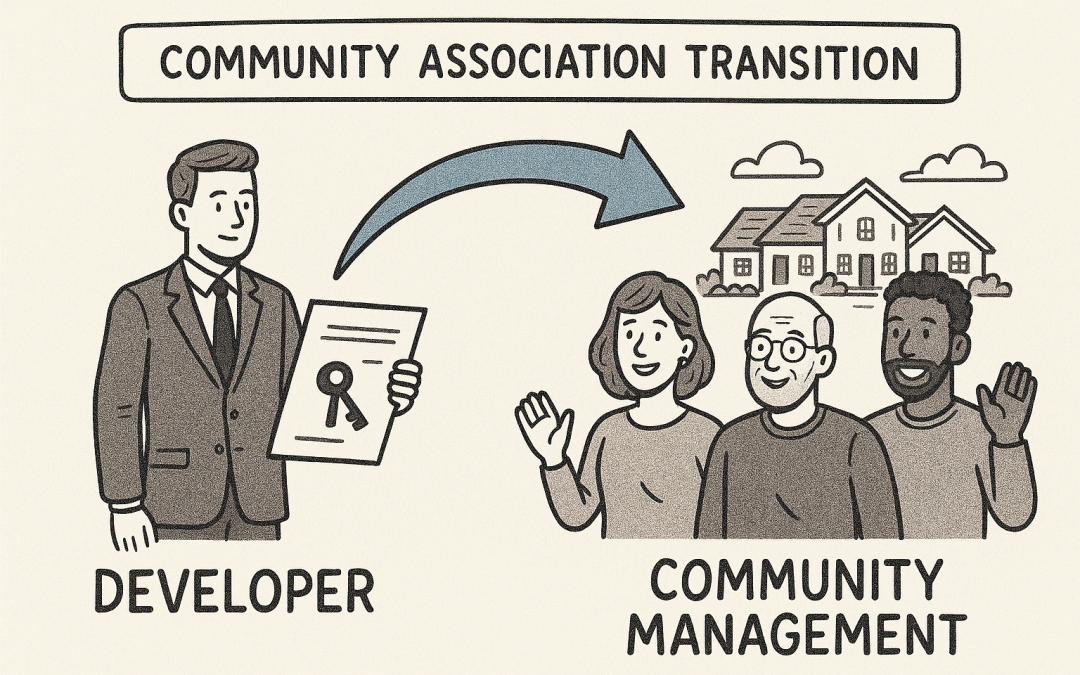
The community association’s transition marks the community’s gradual transfer from developer to association control. The transition process can take months—or even years—and looks different for every community. Regardless of the timeline specifics, the process always begins when the developer builds a housing development and ends when ownership and responsibility of the community is transferred to the association.
Why is a Transition Study Needed?
The transition study identifies construction defects or incomplete work while also evaluating the adequacy of the developer and reserve funds for future repairs. It also serves as a critical accountability tool, holding the developer accountable to fix any outstanding issues before the association assumes control.
The purpose of a transition study is to ensure a smooth shift of community control. A transition study equips the new board with a thorough understanding of the community and confidence that it has been handed over in sound condition.
For a more in-depth read, check out CAI’s Best Practices for Transitions.

Transition Study F.A.Q.’s
When the time comes for your community’s transition, Kipcon knows you’ll have questions. To help you with your journey, Senior Project Manager, Melissa Wrubel, PE, shared the most common Transition Study related questions she’s received.
Q: “We don’t have design plans. Can the Transition Study still be prepared?”
A: The main purpose of a Transition Study is to compare the constructed common elements to the approved design documents. The study cannot be performed without them. The Association may be able to obtain the necessary documents through an Open Records Act request to the municipality, or by requesting them from the contractor.
Q: “Will you review the building construction for code compliance?”
A: A Transition Study is not intended as a comprehensive building code review. The intention is to make a general comparison of the as-built construction to the approved design plans. Municipal, County, and State approved design plans have already been reviewed for compliance with jurisdictional requirements and building code requirements. However, if a deficiency is identified during observation which also violates the applicable building code, the specific violation will be noted in the study.
Q: “Will you provide an estimate to remediate any deficiencies you observe?”
A: Remedial estimates are not prepared based on visual observations at the time of the Transition Study. There are two main reasons for this. The developer should first be given an opportunity to respond to the deficiency summary outlined in the study. Some items may warrant a reasonable explanation or resolution from the developer. Remedial estimates are typically prepared after the developer has provided a response and are prepared as a follow-up service to the initial Transition Study. The need for a detailed remedial estimate should be discussed with your transition attorney.
Q: “What kinds of technical testing would be helpful?”
A: Although the initial Transition Study does not typically include technical or invasive testing, in some instances testing may be warranted to determine the source of visually observed issues. A range of material testing and field investigation methods can be used to help determine concealed sources of deficiency. These can typically include, but are not limited to, asphalt core sample testing, moisture probe testing at building facades, thermographic imaging, and concrete core sample testing. Because technical testing involves additional—sometimes significant—costs, it is often best reserved for components with clear or obvious deficiencies.
Still Have Questions? Want to Know More?
If your community is beginning the Transition process, Kipcon is here for you! Contact us today at (800) 828-4118 or click here.
You can also check out Kipcon’s December 2025 webinar, Community Association Transition: Exploring the Process & Minimizing Risks, to learn more!
Valuable CAI Reference Library Below: